
Seoul's living sector rests on two demand bases. Korean households are the larger one. Foreign residents are smaller but growing, and among them international students are the group a student-housing (PBSA) or co-living operator can serve most directly. Are Seoul's dormitories and the rooms run by professional operators keeping pace with the growth in international students?
- 62,9021
- April 1, 2026 · +26.1% on 2022
- 6.0%2
- +13,028 students
- 1 : 84
- 2023–2025
- 67%2
- Seongbuk, Gwangjin, Nowon
International degree enrollment rose 26% in four years
Seoul's universities enrolled 62,902 international students in degree programs on April 1, 2026, 26% more than in 2022.12 Most of the growth came after 2023, and enrollment rose 13.3% in the latest year alone.2 Most of them are undergraduates. Another 31,234 students in non-degree programs, mostly language trainees, are left out of the figures that follow.1
Counting all programs, Seoul's international students grew 15.9% in the latest year, part of a 21.3% rise across Korea.13 Within the city, three districts took two-thirds of the gain. They are Seongbuk-gu, home to Korea and Kookmin universities, Gwangjin-gu, home to Konkuk and Sejong, and Nowon-gu.2
Dormitory residents rose by one for every eight new students
Enrollment rose by 7,409 from 2023 to 2025; dormitory places for them by 950
- degree students, 2023–2025
- +15.4%
- of them in a dormitory
- +12.7%
- added dormitory residents to added students
- 1 : 8
+7,409 students against +950 dormitory residents.
- degree students, 2023
- 48,116
- in a university dormitory
- 7,456
- dormitory share, at least
- 15.5%
2023 is the first year both series cover.
- degree students, 2024
- 50,205
- in a university dormitory
- 7,959
- dormitory share, at least
- 15.9%
On 2023: +2,089 students (4.3%), +503 in a dormitory.
- degree students, 2025
- 55,525
- in a university dormitory
- 8,406
- dormitory share, at least
- 15.1%
On 2024: +5,320 students (10.6%), +447 in a dormitory.
University dormitories housed 8,406 international degree students in 2025, 950 more than in 2023. Enrollment rose by 7,409 over the same two years, so dormitories took in about one of every eight additional students.14 In 2025 at least 15% of these students lived in a university dormitory.4
Students outside a dormitory are not without a room. Many rent studios, officetels, multi-living facilities (goshiwon), boarding houses or shared houses, let by individual landlords and small operators. Rooms, upkeep and leases can vary from building to building. A professionally run building can offer one standard and one lease, which may matter most to students new to Korea's rental market.
Rooms run by professional operators sit near some campuses, not others
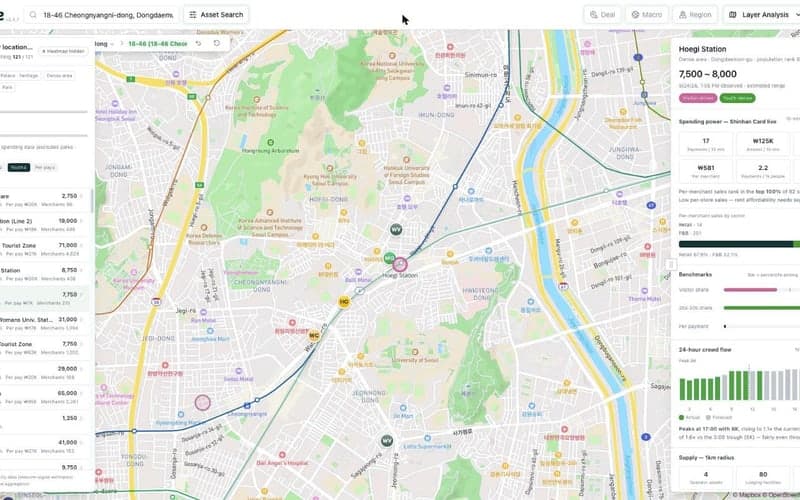
Remarble Earth, our asset register, records 96 operating assets run by professional operators in Seoul, leaving out buildings registered for lodging. Fifty lie within 1.5 km of a university campus and hold at least 5,609 rooms. By each operator's main sector, rental housing accounts for 3,306 of those rooms, co-living for 1,940 and student housing for 363.5
Seodaemun, Dongjak and Jongno have many international students and few operated rooms nearby
| District | Students | Rooms | Per 100 |
|---|---|---|---|
| DongjakChung-Ang, Soongsil | 5,512 | 0 | 0.0 |
| JongnoSungkyunkwan | 3,435 | 0 | 0.0 |
| SeodaemunYonsei, Ewha, Myongji | 7,820 | 138+ | 1.8 |
| DongdaemunKyung Hee, HUFS, UOS | 7,024 | 510 | 7.3 |
| SeongdongHanyang | 4,098 | 299 | 7.3 |
| SeongbukKorea, Kookmin, Sungshin | 10,292 | 996+ | 9.7 |
| GwangjinKonkuk, Sejong | 6,596 | 1,027+ | 15.6 |
| MapoHongik, Sogang | 3,595 | 723+ | 20.1 |
| NowonSeoulTech, Kwangwoon | 3,849 | 792 | 20.6 |
Around the campuses of Seongbuk and Gwangjin, where enrollment grew fastest, there are at least 996 and 1,027 operated rooms, most of them run by rental-housing operators. Seodaemun-gu's campuses, Yonsei, Ewha and Myongji, enroll 7,820 international degree students and have at least 138 operated rooms nearby. Around Chung-Ang and Soongsil in Dongjak-gu, with 5,512 students, and Sungkyunkwan in Jongno-gu, Earth records none.25 Seodaemun's 138 rooms all belong to an operator whose main sector is student housing.5
What this means for investors
The growth in international students adds demand to a private rental market that includes individual landlords, small operators and professionally managed properties. Rooms, upkeep and leases can vary considerably. A professional operator's case rests on consistency: furnished rooms, a maintained building, shared space and a lease a foreign student can follow.
Professional operators have yet to reach many campus districts. Earth records 138 operated rooms around Seodaemun-gu's campuses and none around Dongjak-gu's. Rent, operating cost and competition with the studio, the officetel and the goshiwon will decide where a scheme can work.
Our view
Seoul's growing international student population is expanding the potential market for professionally managed student housing. With many students relying on a diverse private rental market, operators have an opportunity to differentiate through consistent quality and services. Whether that translates into investable demand will depend on affordability, local market economics and an operator able to deliver it.
Notes and sources
Figures without a note number come from the Remarble Earth snapshot of November 2026 and are updated when the data are refreshed; each board gives its own source and as-of date. Figures with a note number come from the source cited in that note and are reproduced as published.
Discussion
Members, under their own name
Loading the discussion…
Comments show your name only — not your company, role or email. Keep them specific and civil; the Remarble team may hide a comment that is not. You can delete your own at any time. Privacy policy