
In the autumn of 2025, two global investors bought living assets in the same Seoul district within two months: Morgan Stanley in September and Invesco in October. Both chose Mapo-gu, a district shared by university students, young adults and foreign visitors, each there for a different reason. With six institutional deals in Remarble Earth's record, Mapo is tied with Dongdaemun-gu for the most of any Seoul district. This brief examines Mapo's demand base, existing living products and the institutional capital already active in the district.
Where Mapo sits
Mapo-gu lies on the north bank of the Han River, facing Yeouido, one of Seoul's three main business districts. From Gongdeok station, Yeouido is three stops away and Gwanghwamun, in the central business district, is four. The Airport Railroad connects Hongik University, Gongdeok and Digital Media City stations to both Gimpo and Incheon airports.1 Hongik and Sogang universities are also located within the district.2
Mapo-gu at a glance
Hover over or tap a district to see its name.
- ResidentsResident registration, 2025
- 369,364
- UniversitiesHongik and Sogang, 25,346 students, 2025
- 2
- Operated living buildingsAt least 861 rooms, November 2026
- 11
- Institutional dealsTied for most of any district, Remarble Earth
- 6
- Airport Railroad stationsHongik University, Gongdeok, Digital Media City
- 3
Three sources of demand
Students stay for a semester or a degree. Hongik and Sogang enrolled 25,346 students in 2025 and had 2,618 dormitory places, about 10 for every 100 students against 15.3 for Seoul.2 Among them were 3,595 international students in campus degree programs on April 1, 2026, 11.8% more than in 2022.3
Young adults stay for years. In 2025, residents aged 20–39 made up 34.4% of Mapo's population, above Seoul's 29.9% average.4
Foreign visitors stay for days. They spent 11.7 million visitor-days in Mapo-gu in the twelve months to August 2026, third among Seoul's 25 districts.5
The student and young-adult populations overlap. What separates the three groups is how long each stays, and so what each rents: a room by the semester, a lease by the year, a stay by the night. For young adults seeking longer-term accommodation, the closest market comparison is the small officetel.
The rent benchmark
Korean rental leases typically combine a monthly rent with a refundable deposit. To account for different deposit amounts, the figures above convert deposits into monthly rent equivalents.
Small officetels, studio flats in mixed-use buildings, are a common housing option for single tenants in Seoul. In Mapo, the converted monthly rent is close to Seoul's average, but the rent per square meter is higher. These officetels provide a useful reference point for the private rental market in which co-living operates, although the figures reflect officetel leases rather than co-living rents.6
What operates, and who invested
As of November 2026, Remarble Earth records 11 operating buildings run by five professional operators (DDPS, MGRV, GH Partners, Cove and Homes) in Mapo-gu, with at least 861 rooms. Together they span formats built for each of the three groups: co-living beside the Sinchon campuses, a student residence and studios in the west of the district, and lodging-licensed buildings for flexible stays near Hongik University and Gongdeok stations. One more is under development: KT Living's 499-room Remark VILL Mapo, a Seoul youth housing project.
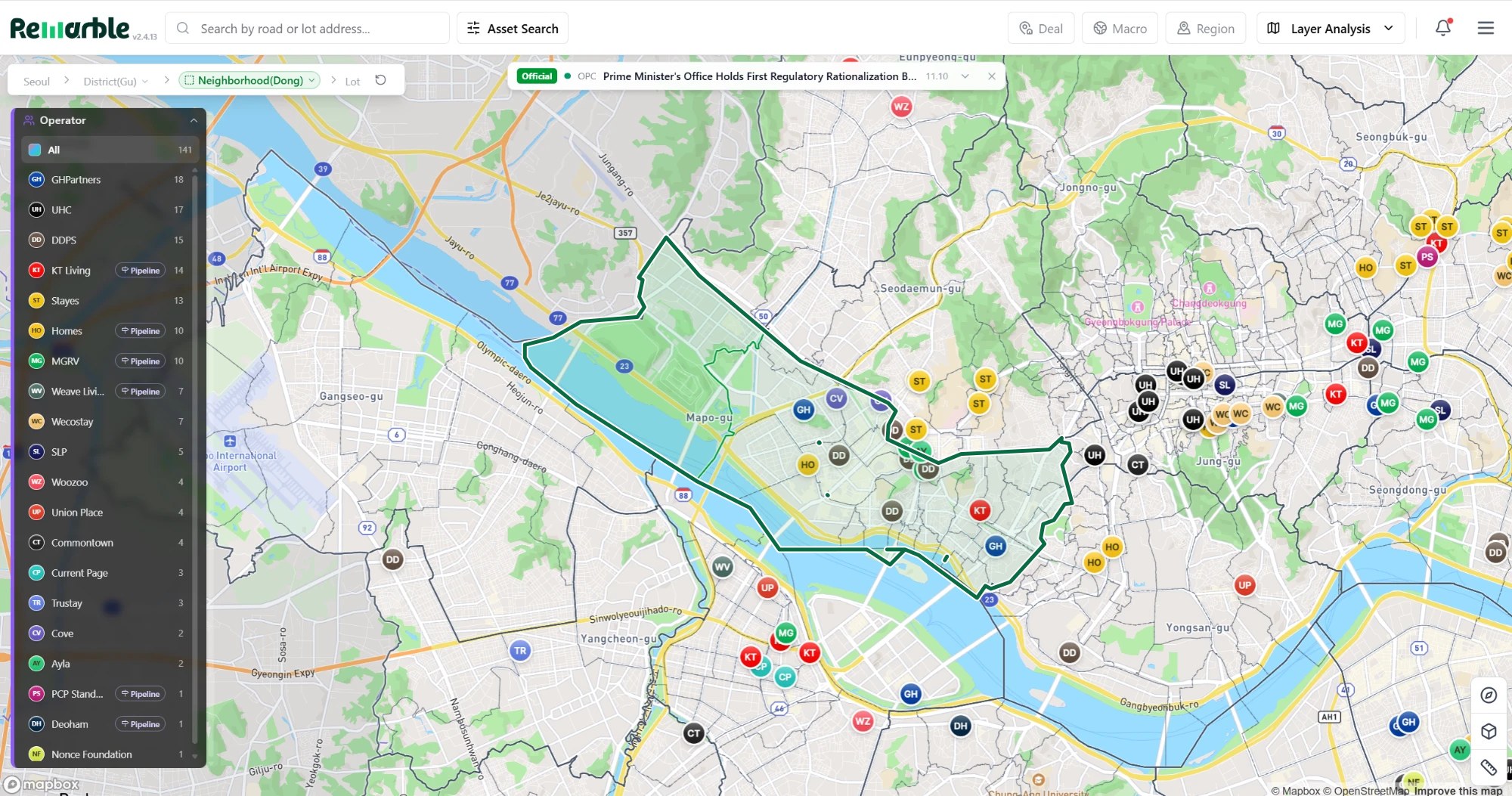
Those buildings have drawn institutional capital. The six deals in Earth's record bring in Korean investors and asset managers, including D&D Investment, IGIS and Mastern, alongside investors from the United States and Singapore. Morgan Stanley bought episode CONVENI Hongdae in September 2025 and Invesco bought Local Stitch CreatorTown Seogyo in October 2025, the most recent deal. GIC invested in two episode buildings in Sinchon through REITs with SK D&D. None is recorded in Mapo so far in 2026; this year's Seoul deals in Earth's record went to Dongdaemun, Jung, Jongno and Gwanak.
Investment perspective
Mapo combines several sources of living demand within one district: university students, young adults and foreign visitors, supported by access to Seoul's business districts and both airports. Its small-unit rental market gives co-living a benchmark, while professional operators already serve different accommodation needs.
Institutional capital has followed, with six recorded deals involving investors such as Morgan Stanley, Invesco and GIC across different living products.
What the record does not yet show is how these buildings perform in operation. Rental income, occupancy and operating costs would help establish how the different living products compare within Mapo's market.
Our view
For investors entering Mapo, the starting point should be the target tenants and the accommodation they already use, rather than the district's overall demand figures. Student housing, co-living and flexible stays serve different markets, and each needs to be assessed against its own local competition.
Notes and sources
Figures without a note number come from the Remarble Earth snapshot of November 2026 and are updated when the data are refreshed; each board gives its own source and as-of date. Figures with a note number come from the source cited in that note and are reproduced as published.
Discussion
Members, under their own name
Loading the discussion…
Comments show your name only — not your company, role or email. Keep them specific and civil; the Remarble team may hide a comment that is not. You can delete your own at any time. Privacy policy