
ⅠThe deal
A former gas station, bought to build rental homes
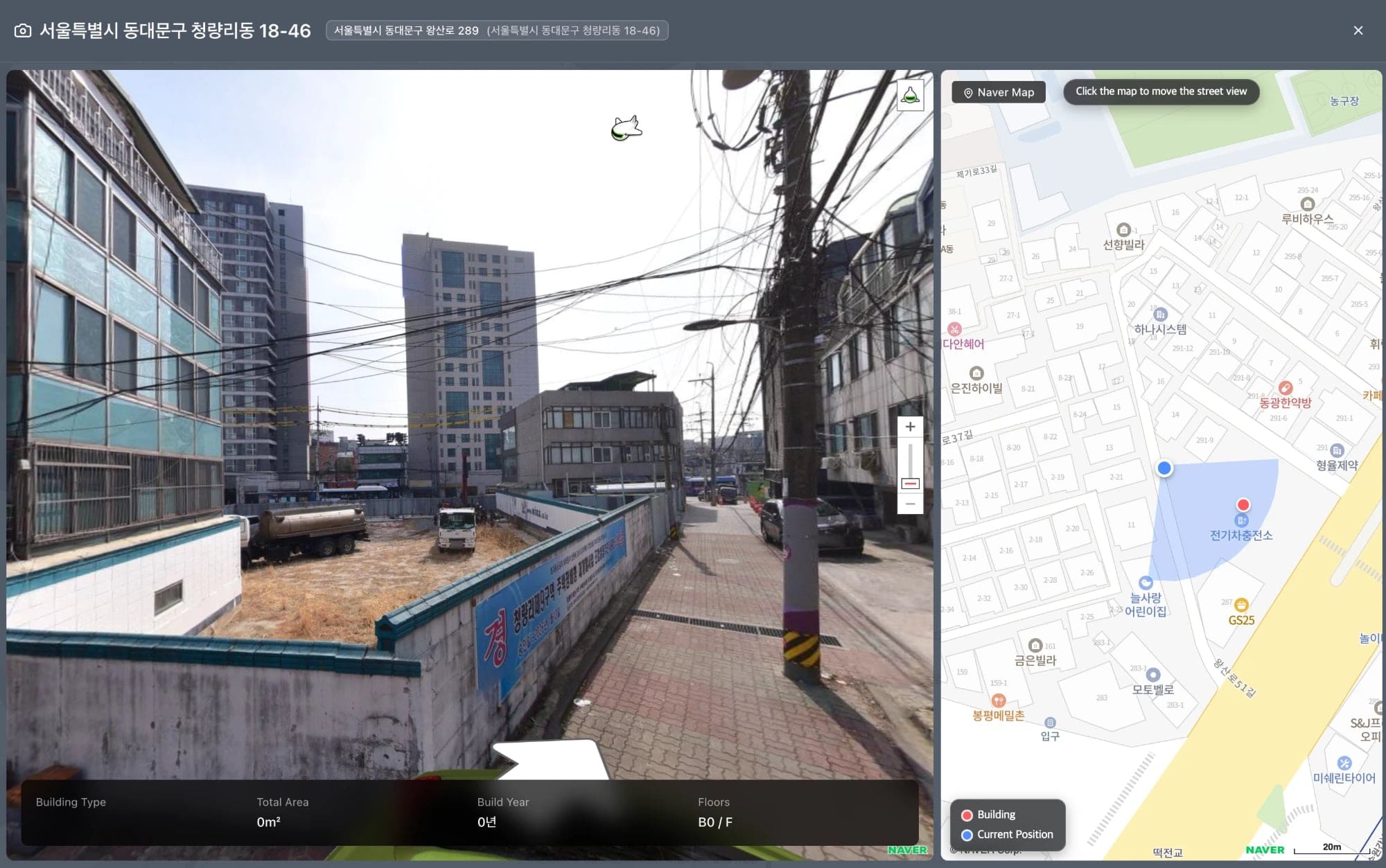
A fund managed by Gravity Asset Management has bought a vacant lot near Hoegi Station for ₩14.0 billion. It plans officetels to lease. Morgan Stanley is reported to be its partner.
- Location
- 18-46 Cheongnyangni-dong, Dongdaemun-gu, Seoul1
- Land
- 1,097 m², gas-station land1
- Price
- ₩14.0 billion (about ₩12.8 million per m²)1
- Seller
- GS Caltex1
- Buyer
- Hoegi Residence Private Real Estate Investment Company2
- Asset manager
- Gravity Asset Management2
- Capital partner
- Morgan Stanley (reported; stake undisclosed)4
- Planned use
- Officetels and ground-floor retail, for lease2
- Transaction date
- Contract Oct 29, 2026; registered Nov 4, 20261
The register shows a straightforward sale of land. On the day title passed, seven savings banks registered a mortgage over the land with a maximum secured amount of ₩39.0 billion.1 A maximum secured amount is the ceiling a mortgage can cover, not the amount borrowed.
The buyer is a private real estate fund set up as a company in September 2026. Gravity Asset Management is its corporate director, the role that manages such a fund. Its registered purpose is to build officetels and ground-floor retail on the lot, then lease and operate them.2 An officetel is a building of small, self-contained units, classed as commercial property but widely rented as homes. The building register still lists the 1998 gas station, and no building permit had been filed by November 14, 2026.3 So the number of units, the cost and the timetable are not yet public.
Morgan Stanley is reported to be partnering with Gravity on the scheme.4 Its stake and terms have not been disclosed. The two have worked together before. Remarble Earth records five Seoul living deals between July 2024 and September 2025 with Morgan Stanley as capital partner and Gravity as asset manager. All five bought existing buildings, four of them already operating. Three sit within one kilometer of a major university: Korea University in Anam-dong, Konkuk University in Hwayang-dong and Hongik University in Sangsu-dong.5 Hoegi is the partnership's first reported land purchase, and it sits in the same kind of location.
ⅡWhy Hoegi?
Four universities, and young residents still arriving
The site sits in a cluster of large campuses with too few dormitory beds, in the district gaining young adults fastest.
- 46
- University of Seoul, Kyung Hee, HUFS, Korea University
- 86,9576
- 2025 · 12,848 dormitory beds
- +6.2%7
- 2022–2025 · 1st of 25 districts · Seoul -2.4%
- +11%9
- 2023–2026 · 3rd of 25 districts
Four universities lie within 1.8 kilometers of the site. The University of Seoul is about 700 meters away, Kyung Hee about 1.1 kilometers, Hankuk University of Foreign Studies about 1.3 and Korea University about 1.8. Together they enrolled 86,957 students in 2025 and had 12,848 dormitory beds, enough for 14.8% of them. Coverage is 17.1% at Kyung Hee, 18.2% at HUFS, 11.1% at the University of Seoul and 11.5% at Korea University. That leaves about 74,000 students at these four campuses to find housing elsewhere, most of it in the private market.6
Four universities around the Hoegi site
- UOS · University of Seoul0.7 km · 10,498 students
- KHU · Kyung Hee University1.1 km · 28,963 students
- HUFS1.3 km · 18,834 students
- KU · Korea University1.8 km · 28,662 students
- students enrolled
- 86,957
- dormitory beds
- 12,848
- dormitory coverage
- 14.8%
Combined for the four universities on the map, 2025. Not the number of students living within the rings.
- students enrolled
- 10,498
- dormitory beds
- 1,170
- dormitory coverage
- 11.1%
University of Seoul alone, 2025. Its main campus is 0.7 km from the site in a straight line.
- students enrolled
- 28,963
- dormitory beds
- 4,946
- dormitory coverage
- 17.1%
Kyung Hee University alone, 2025. Its main campus is 1.1 km from the site in a straight line.
- students enrolled
- 18,834
- dormitory beds
- 3,431
- dormitory coverage
- 18.2%
HUFS alone, 2025. Its main campus is 1.3 km from the site in a straight line.
- students enrolled
- 28,662
- dormitory beds
- 3,301
- dormitory coverage
- 11.5%
Korea University alone, 2025. Its main campus is 1.8 km from the site in a straight line.
Point at a university for its own figures. Tap a university for its own figures. Shaded: Dongdaemun-gu. Dashed rings at 1 km and 2 km; lines are straight-line distances to each main campus point.
The tenants are arriving, too. Seoul lost 2.4% of its residents aged 20 to 39 over 2022–2025, while Dongdaemun-gu gained 6.2%, the most of any district.7 Hoegi Station ranks 4th of the 121 locations in Seoul's real-time city data on the share of people present in their twenties or thirties, at 59.5%. Gangnam Station is at 50.6%. The area is also well placed for work: Hoegi Station is closer to a business center than 81% of Seoul, and closer to a university than 91%.8
Rents have followed. Dongdaemun-gu's average officetel rent, with deposits converted to a monthly equivalent, has risen 11% a year over 2023–2026, the 3rd fastest in Seoul. In 2026 it averaged about ₩993,000 a month, 3% above Seoul's ₩962,000. Cheongnyangni-dong, the site's own neighborhood, averaged about ₩1,081,000, 12% above Seoul. Neighboring Hoegi-dong averaged about ₩710,000, so Cheongnyangni-dong ran about 52% higher. Each figure is a 2026 average of recorded leases on the same basis. None is adjusted for unit size or building type, so the gaps partly reflect what was leased. They show direction rather than a rent the scheme could charge.9
ⅢThe supply gap
A small operated market inside a large rental one
Most students near Hoegi rent ordinary studios and officetels. The professionally run segment is far smaller.
The area's rental housing comes in two kinds. Most of it is ordinary stock: studios in small multi-family buildings, officetels owned unit by unit, goshiwon and shared houses, each run by its own landlord. Remarble Earth does not record that stock. It records the professional segment: whole buildings leased and managed by a named living operator under one owner. For institutions, that segment is one route into the market, alongside ordinary rental buildings, buildings bought to refurbish and sites bought to develop.
That segment is small here. Within one kilometer of the site, Earth records five operating buildings: ACCOMO Hoegi by Homes, Weave Place – Hoegi, two Stayes buildings in Hoegi-dong and WECO STAY Cheongnyangni. Within two kilometers, it records 12 operating buildings with 991 rooms and units. They are a mixed set: four are registered as housing, two as offices, five as neighborhood or education facilities and one as a tourist hotel.10
Set against the four universities, the numbers are uneven. The campuses have about 74,000 students without a dormitory bed;6 the operated buildings within two kilometers hold fewer than a thousand rooms. Not all of those students rent nearby, and operated buildings house young workers too. Even so, professionally run housing reaches only a small part of a large, young rental market.
New operated supply is coming, much of it from institutional capital. Earth records seven institutional living deals within about 2.5 kilometers of the site since June 2024, by six investors, Morgan Stanley's Anam-dong purchase among them. Three were bought before they were operating, including sites in Hwigyeong-dong and Yongdu-dong bought to build on.11 The opportunity lies in the gap between a large tenant base and a small operated stock, and that gap will narrow as these schemes open. Hoegi is one way of reaching it.
ⅣWhat it signals
What this deal signals for Seoul living
Tighter lending rules have changed how capital enters Seoul rental housing. They have not stopped it coming.
Morgan Stanley's reported partnership with Gravity at Hoegi builds on an established relationship.4 Their five earlier Seoul deals all bought existing buildings near universities or transport, four of them already operating when bought. Most are registered as offices or officetels.5 Hoegi keeps the location and the officetel format. What changes is the starting point: land, not a building.
Development gives an owner what an acquisition cannot: the chance to plan the building, its units and its operation from the start. It also carries risks a stabilized building does not. Permits and timetables can slip, and construction costs can run past budget. The land earns no rent until the building opens, and after completion it still has to lease up. Financing and the eventual exit depend on how each of those steps goes. At Hoegi, the scale, cost and rents that will settle the balance are not yet public.
The deal comes as lending rules have tightened. Since September 2025, rental businesses in Seoul cannot borrow against homes they buy.12 Institutional capital has kept coming, by more than one route. Of the eight institutional living deals Earth records since then, five bought sites or buildings not yet operating, and three bought operating buildings. Before the cap, seven of 34 had been bought before operation.13 Within 2.5 kilometers of Hoegi, GIC, TPG Angelo Gordon and CPP Investments have all bought since the cap took effect: one an operating building, two not yet open.11
Which route suits an investor depends on its appetite for risk, its target return, how long it can hold and what it can execute locally. Operating buildings bring income from the first day; refurbishment and development bring more control and more risk. Hoegi sits at the development end, which puts weight on the local partner. That partner directs the fund, whose registered purpose runs from building to leasing and operating.2 Gravity, as the local asset manager, will play a key role in overseeing the development process, coordinating local partners and managing lease-up risks.
Our view
Tighter rules have changed the routes into Seoul's living sector more than they have closed them. At Hoegi, the reported route is development, with a local partner to build and run what goes on the site. The opportunity remains for investors who can match the asset and the partner to the risk they are prepared to carry.
Notes and sources
Figures without a note number come from the Remarble Earth snapshot of November 2026 and are updated when the data are refreshed; each board gives its own source and as-of date. Figures with a note number come from the source cited in that note and are reproduced as published.
Discussion
Members, under their own name
Loading the discussion…
Comments show your name only — not your company, role or email. Keep them specific and civil; the Remarble team may hide a comment that is not. You can delete your own at any time. Privacy policy